Dhanur AI: The Web for AI Agents, The New Revolution
A deep Dhanur AI field guide to the next internet: websites that humans can trust, search engines can understand, and AI agents can safely read, compare, summarize, and prepare approved actions from.
The old web was built for attention
The first commercial web trained businesses to chase visits, clicks, rankings, likes, and form fills. A page was successful if a person found it, stayed long enough to understand the offer, and clicked the next button. Search engines became the main interpreter between a business and the public. That model still matters, but it is no longer enough. A growing share of discovery is moving through AI assistants, answer engines, workflow agents, recommendation systems, and copilots that do not browse like humans. They read structure, compare facts, extract intent, and prepare the next action.
The new web must be readable by agents
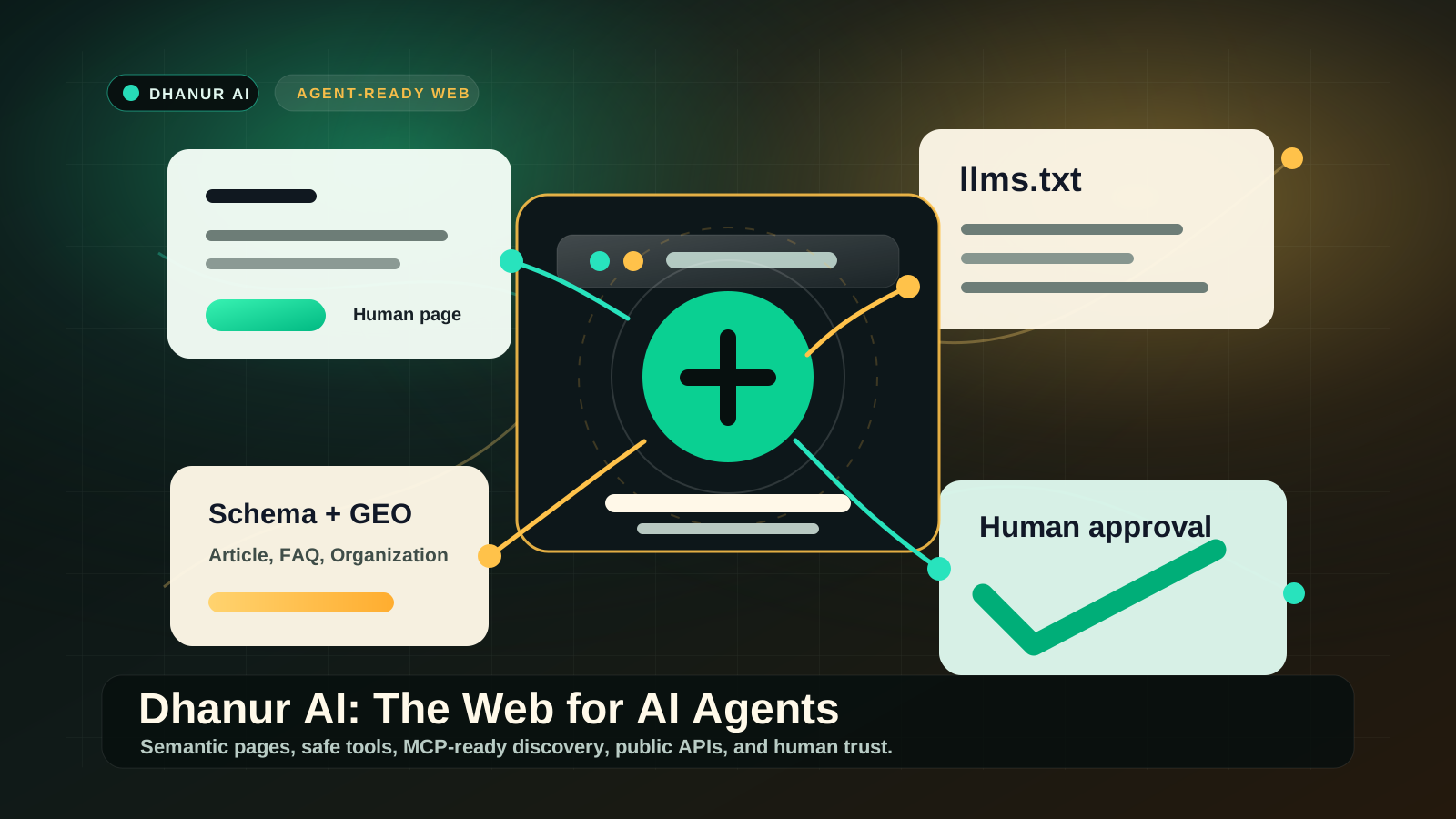
An agent-readable website is not a website with more animation, more cards, or more marketing copy. It is a website with clean meaning. It uses semantic HTML, stable slugs, canonical URLs, clear headings, schema, RSS, sitemaps, public metadata, public read APIs, and llms.txt so an AI system can answer basic questions without guessing. What is this page? Who owns it? What does it offer? Which brand is it connected to? Which product, course, article, channel, or form does it map to? Which actions are safe, and which require human approval? If an agent has to infer all of that from a messy layout, the business is invisible to the next layer of the web.
SEO, GEO, and LLM-readiness now belong together
SEO helps search engines crawl, understand, and rank pages. GEO, or generative-engine optimization, helps answer engines cite, summarize, and recommend reliable sources. LLM-readiness goes further by giving AI systems the operational context they need to help a user. The best modern publishing stack serves all three at once. The page should read beautifully for a person, expose enough structure for search, and carry enough metadata for an agent to connect it to a brand, offer, funnel, newsletter, course, or CRM record.
Content is becoming an operating surface
A blog article used to be a destination. In an agent-readable system, it becomes a node inside the business. A Dhanur AI article can connect to a YouTube channel, a publication page, a store product, a course, a newsletter list, a capture form, a partner campaign, and a dashboard record. That means a reader can ask for resources, an operator can see where the lead came from, and an AI agent can summarize the intent without needing private access. Content stops being a loose asset and becomes part of the operating system.
MCP is the bridge between pages and tools
The Model Context Protocol gives AI agents a safer pattern for discovering resources and calling tools. For Dhanur AI, MCP-ready thinking does not mean handing over the keys to the business. It means designing clear boundaries. Public pages, product catalogs, course pages, articles, and channel metadata can be readable. Drafting, summarizing, scoring, and reporting can be low-risk. Payment creation, refunds, publishing, deletions, partner reconciliation, and legal or financial actions must remain approval-led. This lets the system become powerful without becoming reckless.
Trust is the product feature people will not see first
The visible layer of the new web is convenience. The hidden layer is trust. Agentic systems become dangerous when they can spend money, issue refunds, delete records, message customers, publish public pages, or change partner revenue without review. The agent-readable web needs audit logs, approval queues, role-based permissions, webhook verification, secret isolation, rate limits, and clear risk labels. AI should be excellent at drafting, classifying, summarizing, enriching, and recommending. Humans should approve irreversible financial, legal, publishing, access-control, and deletion actions.
The Dhanur AI use case
Dhanur AI is building a connected system for many channels, publications, products, courses, partners, payments, newsletters, and AI-agent operations. A single founder and manager should be able to see which channel produced attention, which article produced interest, which form produced a lead, which product or course created revenue, and which task needs human review. That is the real promise of the agent-readable web for a creator business. It is not just better content discovery. It is business clarity.
What a proper agent-readable page should contain
A strong page should have a stable URL, a literal title, an honest summary, structured headings, schema markup, canonical metadata, Open Graph metadata, mobile-readable layout, a sitemap entry, and a clear public purpose. It should include AI-readable summaries, clean brand attribution, safe CTA links, and enough context for a model to explain the page accurately. If the page connects to a form, product, course, or newsletter, that connection should carry attribution so the CRM knows where the signal came from.
The business advantage is attribution
Most websites lose context. A person watches a video, reads an article, clicks a product, fills a form, and enters a CRM as a generic lead. That is operational leakage. In the Dhanur AI system, every public surface should preserve the brand, channel, article, product, course, source URL, UTM data, and intent. This is how AI agents become useful to operators. They do not just say someone subscribed. They can say which brand attracted the reader, which topic created intent, and what follow-up should happen next.
Checklist for the agent-ready web
Use stable URLs, descriptive titles, canonical metadata, JSON-LD schema, clean sitemaps, robots.txt, RSS where useful, llms.txt, public read APIs, AI summaries, semantic HTML, newsletter attribution, LAPS capture links, and documented approval boundaries. Avoid hiding core content behind fragile scripts. Avoid vague marketing pages with no operational metadata. Keep mobile layouts fast and readable. Make every page useful to a human, understandable to a search engine, and safe for an AI agent.
FAQ: Will AI agents replace websites?
No. Websites become more important, but their job expands. A good site must serve humans visually, search engines structurally, and AI agents operationally. The winners will be the websites that are clear to all three.
FAQ: Is llms.txt enough?
No. llms.txt is a helpful map, but it should sit beside semantic HTML, schema, sitemaps, RSS, public APIs, stable URLs, and strong permission rules. It is one signal inside a wider agent-readiness system.
FAQ: What should AI agents be allowed to do?
In the first version, agents should read public content, summarize business records, score leads, draft follow-ups, prepare reports, and recommend next actions. They should not send broadcasts, issue refunds, delete records, publish public content, grant paid access, or reconcile partner payouts without human approval.
No approved reader comments yet.
Related reading
AI Operations
How a Two-Person Company Can Run a Multi-Channel Business With AI Agents
A practical Dhanur AI operating model for running many YouTube channels, publications, products, courses, newsletters, leads, and partner workflows with a tiny human team and carefully bounded AI agents.
Real Estate
Real Estate Content Should Create Qualified Buyer Conversations
A Dhanur Real Estate operating guide for turning property videos, location explainers, buyer checklists, and RERA-aware education into serious leads instead of casual views.